English
 Español
 عربى
عربى
 Português

A patio umbrella stand on wheels is a weighted base mounted on casters, engineered so the umbrella and its ballast can move as one unit instead of being lifted and dragged across a terrace. If you have ever wrestled a 35 kg base across stone tiles, the appeal is obvious. But the mobility comes with a measurable cost: a wheeled base needs roughly 20–30% more weight than a static base of the same umbrella size to deliver comparable tipping resistance. In practice, choose a wheeled stand only when you genuinely need to reposition the umbrella during the day, and judge it by base weight, wheel diameter, and brake quality before anything else.
Content
- What Makes a Wheeled Patio Umbrella Stand Different?
- The Main Types of Wheeled Patio Umbrella Stands
- Key Buying Criteria: Weight, Wheel Size, and Brakes
- Stability Risks: When a Wheeled Base Can Become a Hazard
- What B2B Buyers Should Check Before Ordering in Bulk
- Best Use Cases for Wheeled Stands: Commercial vs. Residential
- FAQ
What Makes a Wheeled Patio Umbrella Stand Different?
A wheeled stand is not a static base with casters bolted underneath; it is a different stability system with a higher centre of gravity, a changed footprint, and a strong dependency on brake quality.
Four factors explain why.
- Centre of gravity. Caster housings add roughly 5–10 cm of height under the ballast. That raises the pivot point around which the umbrella rotates, so less horizontal force is needed to start a tip.
- Rolling contact. A static base resists tipping through its floor-contact edge. A wheeled base can roll sideways before that edge engages, which delays the restoring force exactly when a gust hits.
- Brake dependency. With all wheels locked, the base performs close to a fixed model. With one caster unlocked, the assembly can slide, spin, or drift unexpectedly.
- Weight distribution. Wheel spacing, axle positions, and base-plate shape decide how much of the total mass stays inside the umbrella’s support triangle. A base that looks heavy can still be unstable if its footprint is narrow.
The Main Types of Wheeled Patio Umbrella Stands
Most wheeled patio umbrella stands fall into three structural families: wheeled cross bases, wheeled disc bases, and cart-style single-wheel bases.
Wheeled Cross Bases
Cross bases with casters at the end of each arm are the lightest and most common wheeled option. They suit 2.0–2.5 m umbrellas, are simple to warehouse, and are easy to modify from a standard straight-umbrella base. The trade-off is a smaller footprint and less lateral stability than a disc.
Wheeled Disc Bases
Disc bases spread the ballast over a wide circular plate, so the support triangle is larger and the stand feels more planted when tilted. They cost more to ship and take up more floor space, but on commercial terraces they are the safer wheeled choice.
Cart-Style Single-Wheel Bases
Cart-style bases concentrate the ballast in a low trolley with one or two large wheels. They move very easily, but they have the narrowest support footprint and the weakest side-wind resistance. Use them for small balcony umbrellas, not for open patios.
Cross bases are also the most common starting point for suppliers that add a wheel kit to an existing product line. A standard straight-umbrella cross base with a compatible pole receiver gives your wheeled version a clean structure to build on.
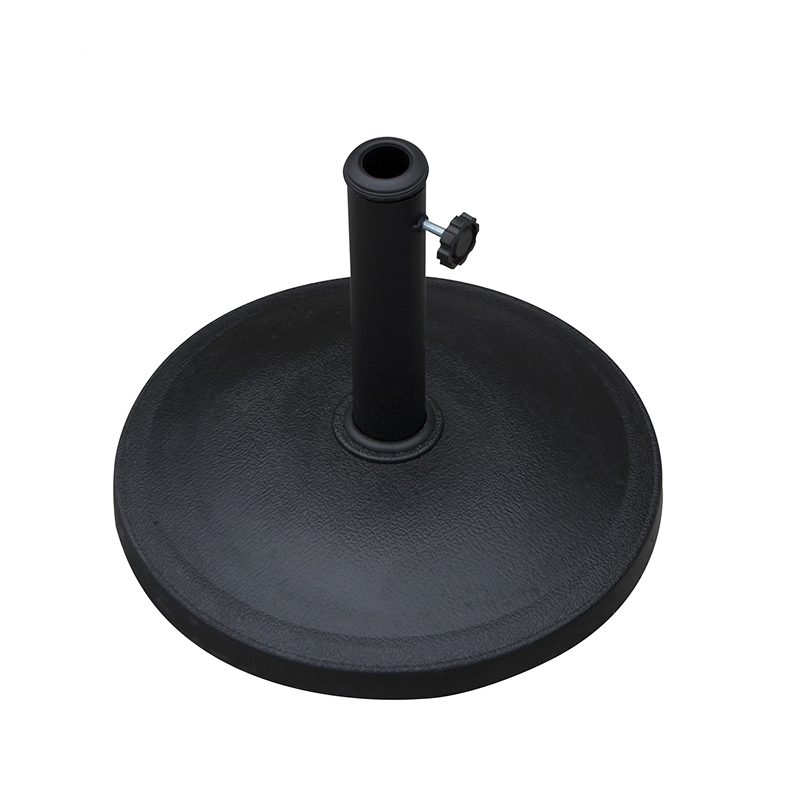 Resin Adjustable Height Base for Straight Umbrella with Anti-Slip PadThis 10 kg resin base offers a stable and durable support for straight umbrellas, with an anti-slip bottom and simple pole insertion. Its moderate size and weight make it a practical choice when evaluating wheeled stand safety.View Product →
Key Buying Criteria: Weight, Wheel Size, and Brakes
Base weight, wheel diameter, and brake type are the three numbers that decide whether a wheeled stand is actually safe, and they should be evaluated as one system rather than as separate checkboxes.
| Umbrella diameter | Static base weight needed | Wheeled base minimum weight | Minimum wheel diameter | Brake requirement |
|---|---|---|---|---|
| 2.0 m | 18–22 kg | 25 kg | 75 mm | Two-wheel lock |
| 2.5 m | 25–30 kg | 35 kg | 100 mm | All-wheel lock |
| 3.0 m | 35–45 kg | 50 kg | 125 mm | All-wheel lock plus tie-down |
The wheeled base needs more weight for a simple reason: wheels lift the ballast and remove the continuous floor-contact edge, so the same wind load acts on a less favourable lever arm. Extra mass compensates for that loss. Below the minimum weights in the table, even a well-built stand can slide across a smooth terrace in a moderate breeze.
Brake design matters as much as total weight. Single caster locks are acceptable only on the lightest stands; for 2.5 m and larger, look for brakes that lock all wheels simultaneously and can be operated by foot. This is where most of the difference between a safe wheeled stand and a cheap one shows up. If you are comparing options, our guide on choosing the right umbrella base explains how the same logic applies to static bases.
Stability Risks: When a Wheeled Base Can Become a Hazard
The real hazard of a wheeled base is that it can slide or tip before the brakes take effect, especially when the umbrella is tilted, the canopy is large, or the wind arrives from the side.
An umbrella canopy behaves like a sail. A 2.5 m circular canopy presents roughly 4.9 square metres of projected area, and at 30 km/h of wind that can generate a horizontal force strong enough to move an unlocked 35 kg stand. The force itself is not extreme; the problem is that a wheeled stand has no built-in resistance to rolling until the brakes bite, and a braked caster still has a smaller contact patch than a static base edge.
Use these rules when positioning a wheeled stand:
- Lock every wheel before use, not just the rear pair or the downhill pair.
- Point the umbrella tilt downwind, or remove the canopy completely when gusts are forecast.
- Add temporary ballast, such as sandbags clamped to the base, on days with strong wind.
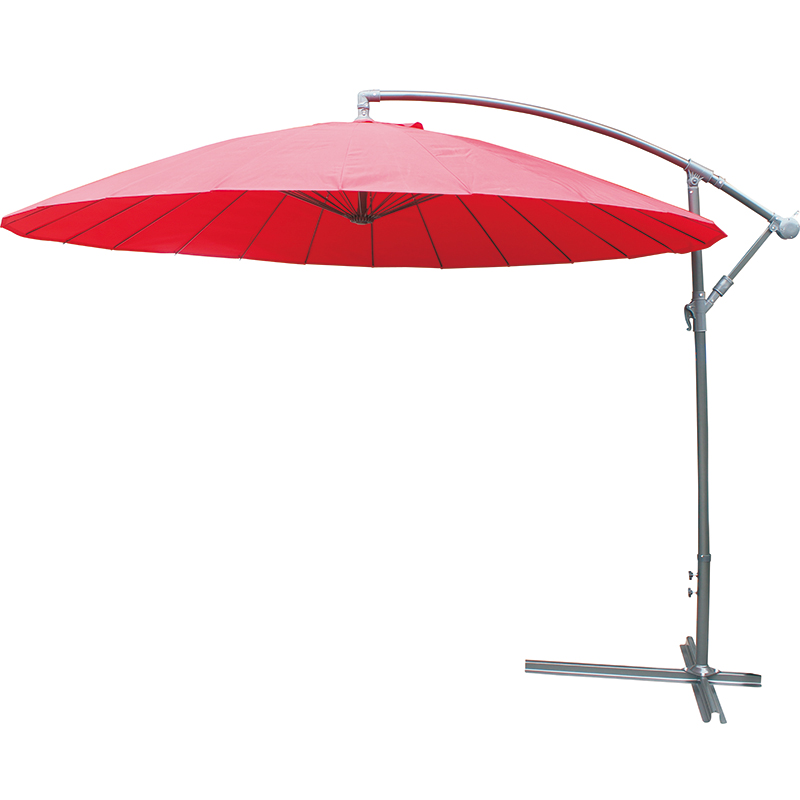
- Do not use a wheeled base for a cantilever umbrella unless the base has been designed and tested for that load path.
Cantilever umbrellas deserve special caution. Because the canopy hangs off-centre, the overturning moment is much larger than on a centre-pole umbrella of the same size, and a conventional wheeled base placed under the mast simply cannot provide the restoring force needed. For these models, suppliers use a dedicated cantilever base with a wider footprint and heavier ballast; castered versions exist, but they are a separate product from a typical wheeled disc or cross stand.
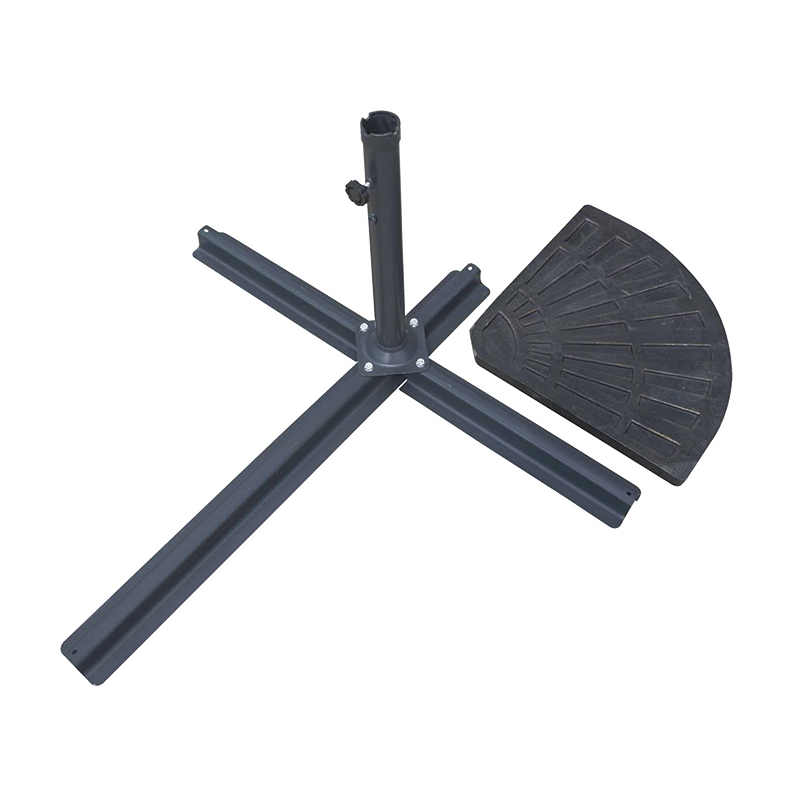 Resin Base for Cantilever Umbrella with Fan-Shaped DesignDesigned specifically for cantilever umbrellas, this 12 kg resin base features a wide fan-shaped footprint and a metal pole interface. Its size and weight help provide the stability needed for off-centre canopies, making it a key option for such setups.View Product →
What B2B Buyers Should Check Before Ordering in Bulk
When you source wheeled umbrella bases in volume, the decision should rest on test data and material evidence, not product photos.
Here are the points we check internally and the points importers should verify with any supplier:
- Wheel load testing. Ask for the rated load per caster and the number of rolling cycles tested. A caster rated for 40 kg may still fail early if its axle is not hardened against repetitive turning.
- Brake cycle testing. A foot brake that fails after a few thousand cycles is unacceptable for restaurant use. Request the cycle count for locking and releasing the brake under load.
- Shell material grade. HDPE stands up to cold weather and UV better than recycled PP. Ask for the material certificate and confirm whether the plastic is virgin, recycled, or blended.
- Corrosion protection. If the caster axle or brake linkage is steel, request salt-spray test results. Coastal patios and poolside areas will reveal rust in months if this detail is skipped.
- Assembly tolerance. The pole receiver diameter and the wheel housing fasteners must match your actual umbrella pole. A 2 mm gap can cause wobble that no brake will fix.
- Pre-production sample. Ask for a fully assembled sample and test it with a loaded umbrella: roll it, brake it, tilt it, and leave it outside for a week before approving mass production.
If the supplier cannot provide cycle-test data for the brakes or the casters, treat that as a warning sign. The same discipline applies to quality control at our factory, where every production step is inspected before the goods are packed.
Best Use Cases for Wheeled Stands: Commercial vs. Residential
Wheeled stands make sense for small and mid-size umbrellas that need to reposition several times a day; they make much less sense for large umbrellas in open or windy areas.
| Use case | Umbrella size | Recommended base | Reason |
|---|---|---|---|
| Café terrace, frequent repositioning | 2.0–2.5 m | Wheeled base, all-wheel lock | Service staff can follow the sun without heavy lifting. |
| Hotel poolside, changing sun angles | 2.5 m | Wheeled base, all-wheel lock, extra ballast | Daily repositioning is necessary and the area is open. |
| Fixed outdoor dining area | 2.5–3.0 m | Fixed weighted base | The umbrella stays in place all day; stability is worth more than mobility. |
| Coastal or high-wind location | Any | Fixed base plus tie-down | A wheeled stand adds avoidable risk where gusts are routine. |
For 3 m and larger canopies that need to move between different serving positions, the safer solution is a static base on a wheeled dolly or a rail system, not a castered base. The geometry of a large canopy simply exceeds what a wheeled base can handle without a disproportionate weight penalty.
FAQ
Can a wheeled patio umbrella stand be as stable as a fixed one?
Not with the same weight. A wheeled base needs roughly 20–30% more ballast than a static base to reach similar overturning resistance, because the casters raise the pivot point and reduce the effective resisting moment. In windy areas, a fixed base is still the safer option.
How heavy should a wheeled stand be for a 2.5 m umbrella?
For a 2.5 m umbrella, plan on at least 35 kg of total ballast for a wheeled stand, compared to 25–30 kg for a static base. The exact figure depends on the canopy fabric, tilt angle, and site exposure.
Are wheeled bases suitable for cantilever umbrellas?
Generally not, unless the base is specifically engineered for cantilever loads. The off-centre canopy creates a larger overturning moment, and a normal wheeled cross or disc stand cannot provide enough restoring force. Use a dedicated cantilever base with caster options if mobility is required.
How do you lock the wheels on a patio umbrella stand?
Most wheeled stands use a foot-operated brake lever on each caster: step down to lock, flip up to release. Some larger models use a central brake bar that pushes both rear wheels simultaneously. Always lock all casters before use, because a single unlocked wheel lets the whole assembly rotate.
What is the best material for a wheeled patio umbrella base?
For the shell, HDPE is the most practical choice because it resists UV, cold cracking, and repeated wetting better than PP. For the wheels, rubberised or polyurethane casters grip better and last longer than hard plastic, and they are quieter when moving across tiles.
The short version is this: a wheeled patio umbrella stand is a service tool, not a universal replacement for a heavy static base. Buy one when you need to move shade several times a day, size it with 20–30% more weight than a fixed base, verify the brake and caster test data, and keep it away from cantilever umbrellas unless the design is purpose-built for them. As a manufacturer of patio umbrellas and their matching bases, we see the difference every season in warranty claims: the stands that fail are almost always the ones where the wheel kit was added after the base was designed, not built as part of it.