English
 Español
 عربى
عربى
 Português

A patio umbrella base should weigh at least 50 lbs (23 kg) for a standard 9-foot umbrella, and 75 lbs (34 kg) or more for larger cantilever or offset models. The right weight depends on your umbrella's canopy diameter, local wind conditions, and whether the base is freestanding or table-mounted. Choosing an undersized base is one of the most common — and most dangerous — mistakes patio owners make. This guide gives you exact weight recommendations by umbrella size, explains the physics behind tip-over risk, and helps you choose the right base material for your setup.
Content
- Why Patio Umbrella Base Weight Matters
- How Heavy Should a Patio Umbrella Base Be? Weight by Umbrella Size
- Cantilever Umbrella Bases: Why They Need So Much More Weight
- How Wind Speed Affects the Weight You Need
- Types of Patio Umbrella Bases: Weight and Material Compared
- Table-Mounted vs. Freestanding Bases: Does the Weight Rule Change?
- How to Add More Weight to an Existing Umbrella Base
- Signs Your Patio Umbrella Base Is Too Light
- Frequently Asked Questions
- Is a 50 lb base enough for a 9-foot umbrella?
- Can I use multiple smaller bases together?
- Is sand or water better for filling a resin patio umbrella base?
- How heavy should a base be for an 11-foot cantilever umbrella?
- Should I bring my umbrella base inside for winter?
- What is the easiest way to move a very heavy umbrella base?
- Does the pole diameter affect how heavy the base needs to be?
- Final Recommendation: How to Choose the Right Base Weight
Why Patio Umbrella Base Weight Matters
An underweight umbrella base is a genuine safety hazard — a tipping umbrella can injure people and cause property damage within seconds of a wind gust.
A patio umbrella canopy acts as a sail. Even a modest 9-foot umbrella has roughly 63 square feet of canopy surface. At a wind speed of just 20 mph, that surface can generate a lateral force exceeding 40 lbs. At 30 mph — a common afternoon gust in many regions — the same umbrella can experience over 90 lbs of lateral force. If the base weighs only 30 lbs, the math is simple and alarming: the umbrella will tip.
Beyond safety, an appropriately heavy patio umbrella base also protects your investment. A falling umbrella typically damages its own ribs and canopy fabric on impact, often requiring costly replacement. A well-matched base pays for itself the first time it prevents a tip-over.
How Heavy Should a Patio Umbrella Base Be? Weight by Umbrella Size
The general rule is that your base should weigh approximately 10 times the canopy area in pounds — but specific umbrella diameter recommendations give you a more practical starting point.
The table below shows the minimum recommended base weight for common patio umbrella sizes under average wind conditions (up to 25 mph gusts). If you live in a consistently windy area — coastal zones, open plains, or elevated terraces — increase each figure by 25 to 40 percent.
| Umbrella Canopy Diameter | Minimum Base Weight (Average Wind) | Recommended Base Weight (Windy Areas) | Umbrella Type |
|---|---|---|---|
| 6 ft (1.8 m) | 25 lbs (11 kg) | 35 lbs (16 kg) | Small market / table |
| 7.5 ft (2.3 m) | 40 lbs (18 kg) | 55 lbs (25 kg) | Standard market |
| 9 ft (2.7 m) | 50 lbs (23 kg) | 70 lbs (32 kg) | Standard / market |
| 11 ft (3.4 m) | 75 lbs (34 kg) | 100 lbs (45 kg) | Large market / cantilever |
| 13 ft (4.0 m) | 100 lbs (45 kg) | 130 lbs (59 kg) | Cantilever / offset |
| 15 ft (4.6 m) or larger | 150 lbs (68 kg) | 200 lbs (91 kg) | Commercial cantilever |
Table 1: Minimum and recommended patio umbrella base weights by canopy diameter and wind exposure.
Cantilever Umbrella Bases: Why They Need So Much More Weight
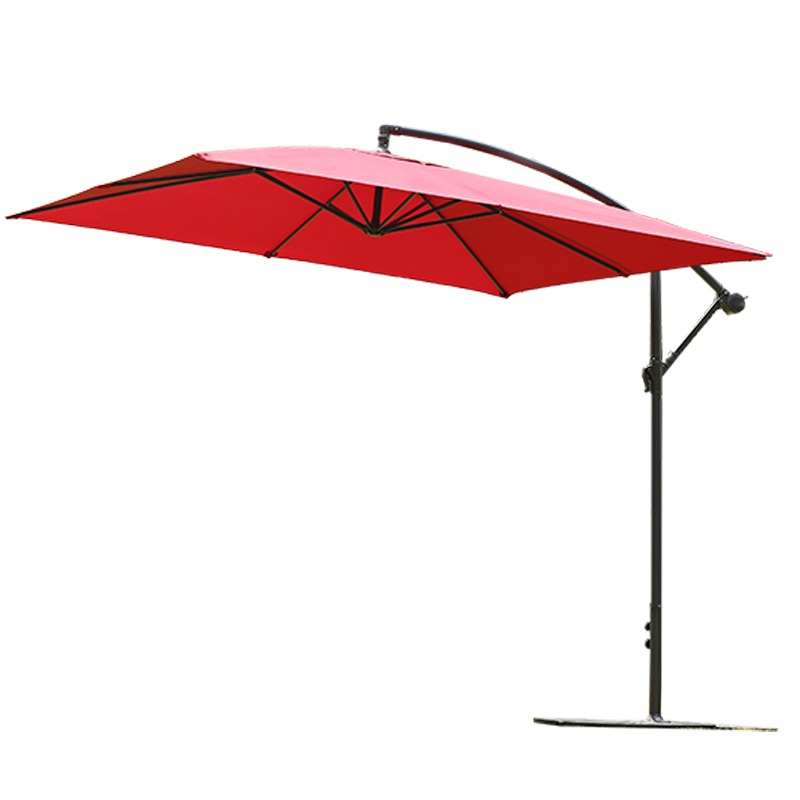
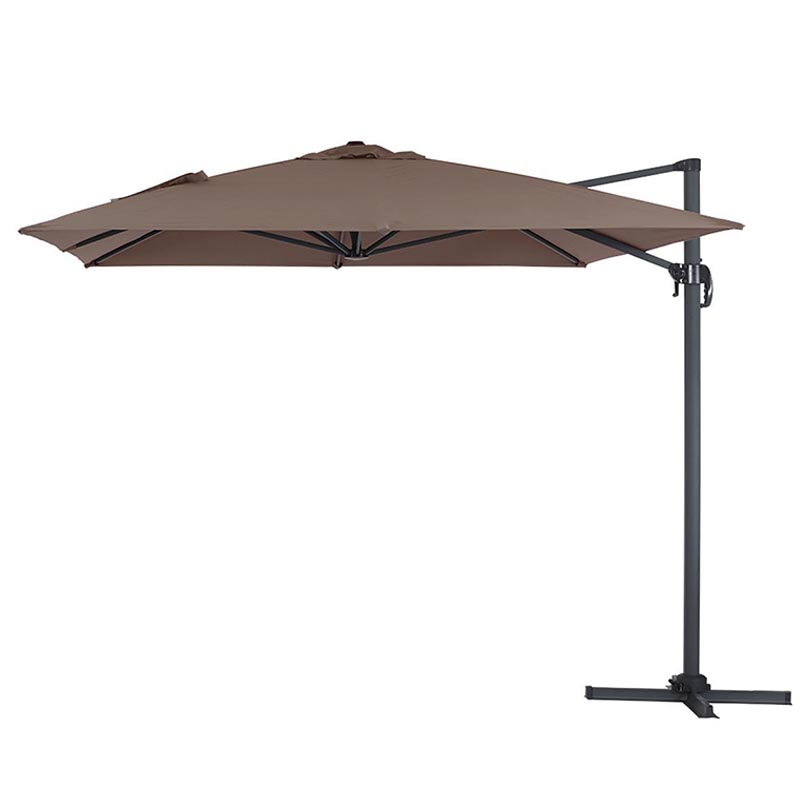
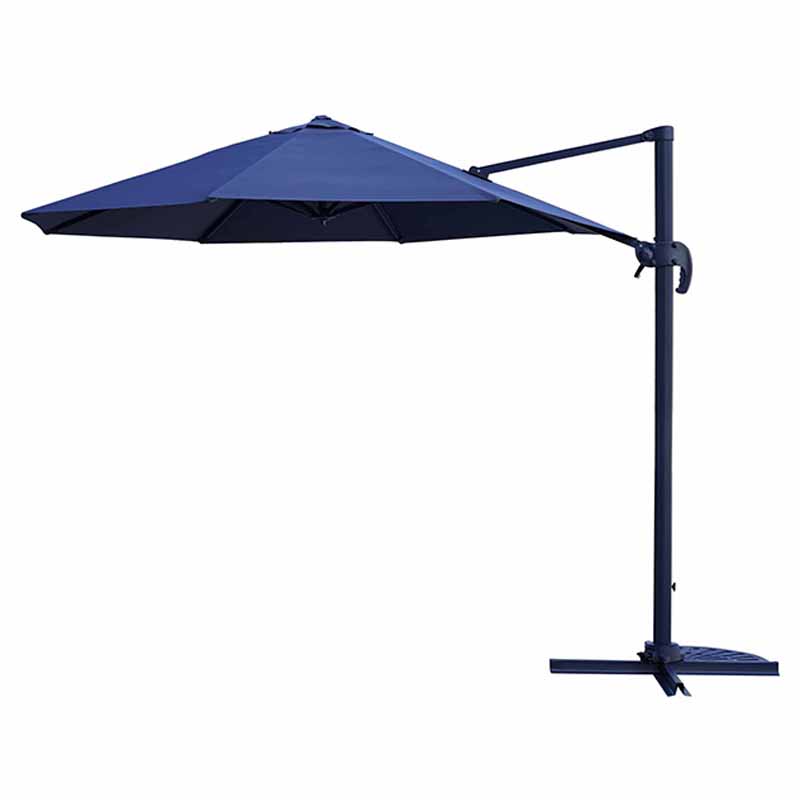
Cantilever and offset umbrellas require significantly heavier bases than center-pole models of the same canopy size — typically 1.5 to 2 times more weight — because the canopy hangs to one side, creating a powerful lever arm effect.
In a center-pole umbrella, the pole runs straight up through the middle of the canopy and transfers load vertically into the base. In a cantilever design, the arm extends outward horizontally before the canopy begins. This offset geometry multiplies the turning force (torque) that wind exerts on the base. A 10-foot cantilever umbrella with a 3-foot arm extension creates roughly twice the tipping moment of a 10-foot center-pole umbrella under identical wind conditions.
For a 10-foot cantilever umbrella in a moderately windy region, a minimum base weight of 100 lbs is realistic — and many outdoor designers recommend combining a 75-lb base with a weighted base ring or cross-bar ballast system to reach 100 lbs total. Do not rely on base weight alone for large cantilever umbrellas; always check that the base footprint is wide enough to resist tipping in the direction the canopy extends.
How Wind Speed Affects the Weight You Need
Wind force on a canopy increases with the square of wind speed, which means doubling the wind speed quadruples the force — and your base weight requirement can increase dramatically in exposed locations.
This relationship — known as the drag force equation — explains why coastal homeowners and rooftop patio owners often need bases that seem disproportionately heavy compared to their canopy size. The table below illustrates the lateral force generated on a standard 9-foot umbrella at different wind speeds.
| Wind Speed | Approximate Lateral Force on 9 ft Umbrella | Minimum Recommended Base Weight | Risk Level |
|---|---|---|---|
| 10 mph (16 km/h) | ~10 lbs (4.5 kg) | 30 lbs (14 kg) | Low |
| 20 mph (32 km/h) | ~42 lbs (19 kg) | 50 lbs (23 kg) | Moderate |
| 30 mph (48 km/h) | ~92 lbs (42 kg) | 75 lbs (34 kg) + close umbrella | High |
| 40 mph (64 km/h) | ~163 lbs (74 kg) | Close umbrella immediately | Extreme |
Table 2: Estimated lateral wind force on a standard 9-foot patio umbrella and recommended base weight at various wind speeds. Note: no base is safe in 40 mph winds — always close the umbrella.
The key takeaway from this data: even the heaviest freestanding patio umbrella base is not a substitute for closing the umbrella in high winds. At 30 mph and above, closing and securing the canopy is always the correct action, regardless of base weight.
Types of Patio Umbrella Bases: Weight and Material Compared
The material your base is made from determines its weight density, durability, appearance, and price — and each material has a distinctly different weight-to-size ratio that affects how practical it is to move and store.
Cast Iron Bases
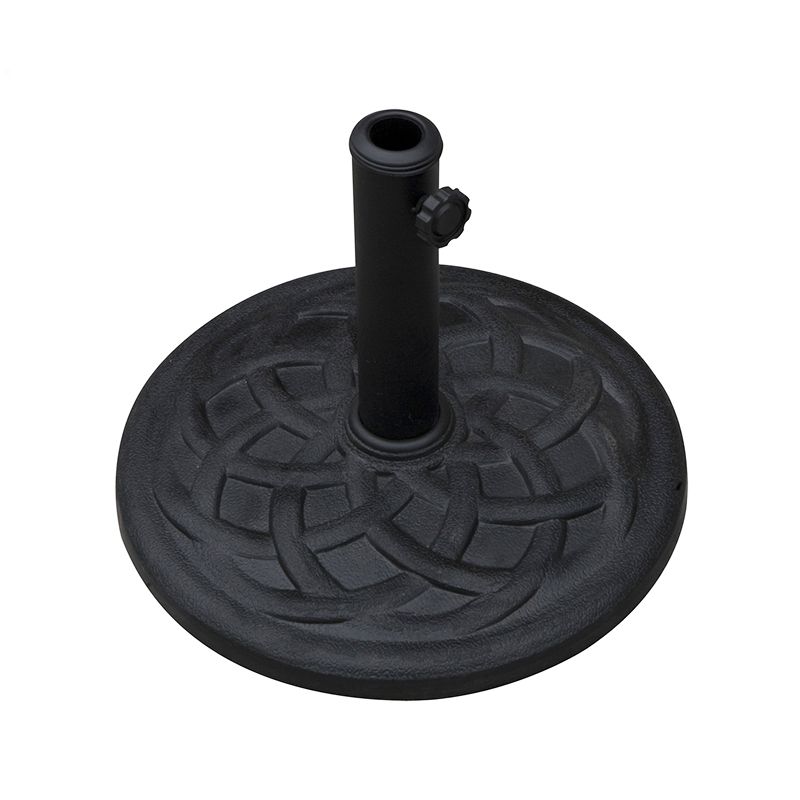
Cast iron is the densest and heaviest of all common base materials. A cast iron base measuring 18 inches in diameter can weigh 50 to 70 lbs — excellent stability in a compact footprint. However, cast iron is brittle and can crack if dropped, and it will rust if the protective coating is scratched and left untreated. Best for: permanent or semi-permanent umbrella placements where the base rarely moves.
Resin / Plastic Fill Bases
These bases arrive nearly empty and are filled with sand or water on-site. A water-filled base holds approximately 8.3 lbs per gallon; a sand-filled base holds around 12 to 13 lbs per gallon. A typical 10-gallon resin base filled with sand reaches 120 to 130 lbs — making it one of the heaviest options available. The trade-off is that the base is bulky and the fill material can shift or drain over time if seals degrade. Best for: buyers who need maximum weight without the transport challenge of cast iron or concrete.
Concrete Bases
Pre-cast concrete bases offer excellent weight at a low cost per pound, but they are the least attractive option and can chip or stain over time. They are extremely difficult to move once in place. Some homeowners pour a custom concrete footing directly in the ground for a permanent installation — this is the most wind-resistant solution possible but eliminates all mobility. Best for: commercial installations or homeowners who never plan to relocate the umbrella.
Steel Bases
Powder-coated steel bases balance weight, durability, and aesthetics. They are lighter than cast iron (typically 30 to 55 lbs for a freestanding model) but more corrosion-resistant when properly coated. Cross-base and X-base designs in steel are popular for market umbrellas because they tuck neatly under a patio table. Best for: mid-size umbrellas paired with dining tables where portability is occasionally needed.
Granite or Stone Bases
Natural stone bases, particularly polished granite, are the premium aesthetic choice. A solid granite base 18 inches in diameter and 6 inches tall weighs approximately 65 to 80 lbs — competitive with cast iron while offering superior weather resistance and visual appeal. They are expensive, ranging from $80 to $250, and heavy to ship. Best for: high-end outdoor living spaces where appearance is a priority.
| Base Material | Typical Weight Range | Portability | Durability | Approx. Price |
|---|---|---|---|---|
| Cast Iron | 50 - 80 lbs | Low | High (if coated) | $40 - $150 |
| Resin / Plastic Fill | 80 - 130 lbs (filled) | Medium (drain to move) | Medium | $30 - $100 |
| Concrete | 60 - 120 lbs | Very Low | High | $20 - $80 |
| Powder-Coated Steel | 30 - 55 lbs | Medium | High | $35 - $120 |
| Granite / Natural Stone | 65 - 90 lbs | Low | Very High | $80 - $250 |
Table 3: Patio umbrella base materials compared by weight, portability, durability, and estimated price range.
Table-Mounted vs. Freestanding Bases: Does the Weight Rule Change?
Yes — when an umbrella is mounted through a hole in a heavy patio dining table, the table itself contributes significant stabilizing weight, which reduces the standalone base weight you need.
A solid cast aluminum or teak dining table can weigh 40 to 80 lbs on its own. When an umbrella pole passes through the table's center hole and into a base underneath, the table's weight and footprint add meaningful resistance to tipping. In this configuration, a 25 to 35 lb base is often sufficient for a 9-foot umbrella, whereas a freestanding arrangement with the same umbrella requires 50 lbs or more.
However, this only applies when the table is specifically designed for umbrella use with a center pole hole, and when the table itself is not at risk of sliding. On smooth tile or polished concrete, a dining table can shift in strong wind, taking the umbrella with it. If your patio surface is slippery, anchor the table with non-slip pads or use a heavier freestanding base regardless.
How to Add More Weight to an Existing Umbrella Base
If your current base is too light, the most practical solutions are adding a weighted base ring, stacking a second base, or bolting the pole to a permanent surface anchor.
- Weighted base rings: Donut-shaped rings that slip over the pole and rest on top of the existing base. Available in 20 to 50 lb increments, these are the easiest add-on weight. Two stacked rings on a 50 lb base gives you 90 to 100 lbs total with minimal footprint change.
- Sandbags: Placing sandbags around the base perimeter adds weight quickly and cheaply. A standard 50 lb landscape sandbag placed against the base roughly doubles the effective resistance to tipping on that side. Use two or three bags arranged around the base for balanced stability.
- Fill-type upgrades: If your base is a fillable resin model, switching from water fill to sand fill adds 30 to 50 percent more weight without buying a new base.
- Deck mount sleeves: For permanent installations on decking, a threaded sleeve bolted through the deck boards eliminates the need for a heavy base entirely. The umbrella pole slides into the sleeve and is locked by friction or a set screw. This is the most wind-resistant solution for flat surfaces where drilling is possible.
- Paver or concrete anchor: On patios without decking, setting the base into a shallow poured concrete pad or surrounding it with heavy natural stone pavers effectively anchors it to the ground. This approach is semi-permanent but highly effective.
Signs Your Patio Umbrella Base Is Too Light
The clearest warning sign that your base is too light is visible wobbling or tilting of the pole during normal afternoon breezes — not just in strong gusts.
- The pole leans noticeably to one side even when the umbrella is closed.
- The entire base lifts slightly off the ground on the windward side during gusts above 15 mph.
- You find the umbrella tipped over after overnight wind — even if you did not notice a storm.
- The base slides across the patio surface in wind rather than staying in place.
- The canopy swings excessively side to side, indicating the pole is not properly restrained at the base.
Any one of these signs is sufficient reason to upgrade your patio umbrella base weight before the next windy day.
Frequently Asked Questions
Is a 50 lb base enough for a 9-foot umbrella?
A 50 lb base is the minimum for a 9-foot umbrella in average wind conditions (up to 20 to 25 mph gusts). If you live in a coastal area, an open yard with no wind-blocking structures nearby, or on an elevated deck, you should use 65 to 75 lbs. A 50 lb base with a 20 lb weighted ring is a practical upgrade that many patio designers recommend as a standard configuration for 9-foot umbrellas.
Can I use multiple smaller bases together?
Only if they are specifically designed to stack or interlock. Random stacking of incompatible bases can create an unstable tower that tips more easily than a single properly-sized base. Weighted rings and stacking base systems are purpose-designed for this purpose and are always a better choice than improvised combinations.
Is sand or water better for filling a resin patio umbrella base?
Sand is significantly better. Sand weighs approximately 12 to 13 lbs per gallon compared to water at 8.3 lbs per gallon — a difference of 35 to 55 percent more weight for the same volume. Sand also does not evaporate, does not freeze and crack the base in winter (when drained), and does not promote mold growth inside the base. The only downside is that sand is harder to pour out if you need to move the base.
How heavy should a base be for an 11-foot cantilever umbrella?
An 11-foot cantilever umbrella requires a minimum base weight of 75 to 100 lbs in sheltered locations and 100 to 130 lbs in exposed or windy areas. Because the canopy hangs off to one side, the base must be positioned so that the heaviest side of the base is opposite the canopy overhang. Many cantilever umbrella systems include a dedicated cross-base frame designed to be loaded with additional weight plates — always use this system as intended rather than substituting a circular base.
Should I bring my umbrella base inside for winter?
For fillable resin bases, always drain them before winter if temperatures in your area drop below freezing. Water expands by about 9 percent when it freezes, which can crack or deform the base shell permanently. Cast iron, steel, and granite bases can generally remain outdoors year-round, though covering them helps preserve any painted or coated surfaces. Regardless of base material, always store the umbrella canopy indoors or in a weatherproof cover during winter months.
What is the easiest way to move a very heavy umbrella base?
The easiest method is to place the base on a low platform dolly with locking casters before filling it. When you need to move it, unlock the casters and roll. For bases already in place, a two-wheel hand truck with a strap can move a 100 lb base safely with one person. Never attempt to carry a base over 50 lbs without lifting assistance — the awkward center-hole geometry makes it particularly prone to dropping.
Does the pole diameter affect how heavy the base needs to be?
Pole diameter affects fit and wobble, not base weight requirements. A loose-fitting pole in an oversized socket will allow more lateral movement at the canopy level, which increases the effective force on the base. Always match pole diameter precisely to the base socket — most residential umbrellas use 1.5-inch or 1.75-inch poles, while commercial models often use 2-inch poles. Using a rubber or foam sleeve to fill a loose socket reduces wobble and improves stability without requiring a heavier base.
Final Recommendation: How to Choose the Right Base Weight
Start with the umbrella size chart above, add 25 percent if your patio is exposed or elevated, and always go heavier rather than lighter — the cost difference between a 50 lb and a 75 lb base is rarely more than $30, but the consequences of an underweight base can be far more expensive.
For most homeowners with a standard 9-foot market umbrella, a 65 to 75 lb cast iron or filled resin base is the practical sweet spot: heavy enough for daily use in typical wind conditions, yet still movable by two people. For cantilever umbrellas 11 feet or larger, plan for 100 lbs minimum and use a cross-base design with fill plates for maximum stability.
Most importantly, remember that no patio umbrella base eliminates the need to close the umbrella in strong wind. Think of your base as a first line of defense against everyday breezes — not a guarantee against storm-force gusts. Close the canopy when the wind picks up, and your umbrella, your patio furniture, and your guests will all be safer for it.