English
 Español
 عربى
عربى
 Português

Short answer: a scalloped edge patio umbrella is a standard market, Roma, cantilever or balcony umbrella whose canopy perimeter is finished with a wave-shaped valance — a run of sewn or die-cut arcs hanging roughly 4 to 10 cm below the lowest rib line. The scallop adds no shade. It changes how the umbrella looks, how much fabric it consumes, and how the hem behaves in wind and rain.
For a hotel terrace, a café, a balcony or a coastal rental, the decision usually comes down to three things: does the silhouette suit the space, will the fabric survive a season of UV and rain, and can the frame keep the canopy steady when the wind picks up. Frame stiffness, vent design and base weight matter far more than the hem shape, and all three can be written into a specification in plain numbers.
Content
- What Counts as a Scalloped Edge
- Scalloped vs Straight Edge: What Actually Changes
- Which Frames Carry a Scalloped Canopy Best
- Fabric, Coating and Colour Choices
- Wind, Rain and Tipping in Real Use
- Sizing: Matching the Canopy to the Space
- Specifying a Custom Scalloped Canopy
- Sample Checks and Common Questions
What Counts as a Scalloped Edge
A scalloped edge is a decorative perimeter treatment, not a structural one. Every load the canopy carries still runs through the ribs, hub and pole; the valance only hangs from the rib ends, so it never decides whether the umbrella survives a gust.
How the edge is built
Almost all scalloped canopies come from one of three production routes, and the route shows up in how the hem ages.
- Die-cut panel. The wave is cut into the canopy itself. Cleanest look and no seams to fray, but it wastes fabric at the perimeter and the edge cannot be replaced alone.
- Sewn valance strip. A separate arc-cut strip is stitched around the hem. The most common method in export orders and the easiest to restyle or replace later.
- Bonded trim. Fast and cheap on light polyester, but the bond line is usually the first failure point after a season of UV and folding.
Names used in catalogues and quotations
The same feature appears under several labels, which matters when you compare quotes from different suppliers.
- Scalloped valance, wave edge, wavy hem
- Picot edge — a finer, smaller arc
- Flower or petal edge — deeper arcs, often on square canopies
- Tiki or thatch edge — scallops combined with a grass-look fringe
Scalloped vs Straight Edge: What Actually Changes
Fabric consumption, hem stiffness, wind noise and cleaning effort change; shading and UV protection do not. On the same frame and canopy size, a scalloped hem is a styling decision with a small but real operational cost.
| Factor | Scalloped edge | Straight edge |
|---|---|---|
| Visual effect | Soft, traditional silhouette; hides rib tips | Minimal, architectural |
| Fabric use | 5–12% more for the same canopy size | Baseline |
| Hem stiffness | Lower; arcs flex independently | Higher; continuous hem line |
| Wind behaviour | More flutter from about 4–5 m/s upward | Quieter, less perimeter drag |
| Rain and drying | Each arc drips at its low point; dries unevenly | Drains along one straight line |
| Repair | Sewn valance can be replaced on its own | Whole panel usually replaced |
| Cost impact | Roughly 3–8% higher per unit | Baseline |
| Best fit | Gardens, terraces, resort and tiki themes | Contract, retail, high-wind sites |
Which Frames Carry a Scalloped Canopy Best
Roma and cantilever frames carry scallops best, followed by balcony half-umbrellas and classic crank-open market umbrellas. A fairly flat canopy of 2.5 to 3.0 m with eight or more ribs gives the hem enough drop to read as a wave; very small or very shallow canopies make the arcs look cramped.
Roma and cantilever frames
Roma umbrellas already work in tiers and curved lines, so a scalloped valance continues a language the frame has started. Cantilever versions keep the pole clear of the table, which is what cafés and hotel terraces usually need. As a rule of thumb, allow one complete wave for every 25 to 35 cm of finished perimeter.
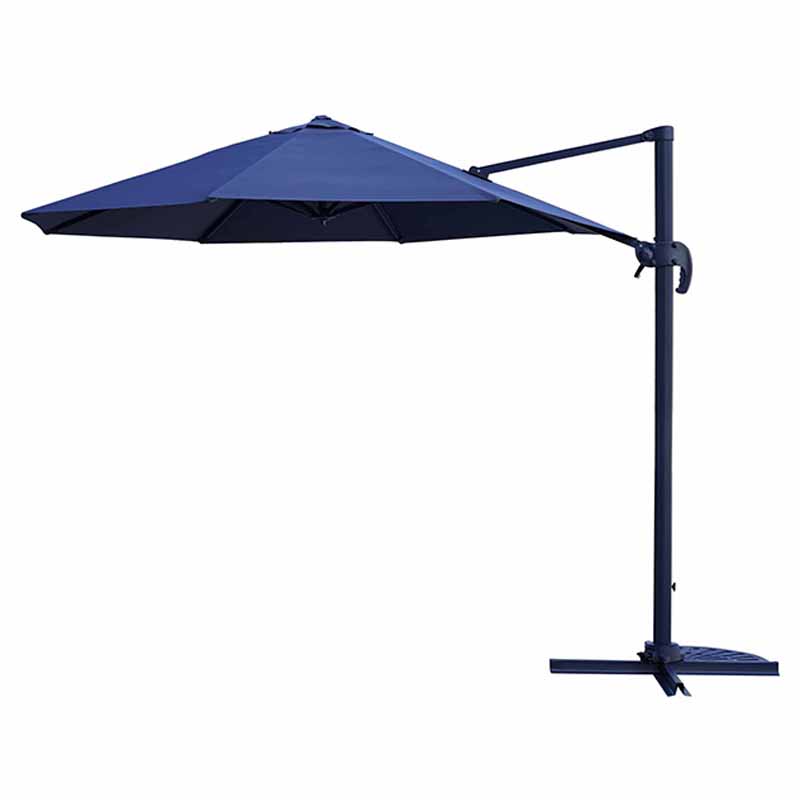 Cantilever Roma Umbrella GP1931 for Cafés and TerracesOffset aluminum-frame cantilever parasol with 200g UV-resistant polyester canopy in 3.0m or 3.5m, keeping tabletops clear.View Product →
Classic crank-open market umbrellas
A straight-pole crank frame with a scalloped hem is the workhorse version: easy to reorder, easy to repair and simple to pair with a plain square base. It suits restaurant terraces where every table needs the same silhouette.
Balcony and half umbrellas
Half-canopy balcony umbrellas are often sold with a wave edge because the flat side against the wall is a natural place for it. Check wall clearance first: the valance hangs below the frame line, so the bracket may need to sit a little higher than the drawing suggests.
Fabric, Coating and Colour Choices
For a scalloped hem, pick a fabric that holds a crease and resists fraying: 220 g/m² solution-dyed polyester or acrylic outperforms light 180T polyester, and the heavier weave keeps the arcs hanging evenly instead of curling.
| Fabric | Weight | UV performance | Notes for scalloped hems |
|---|---|---|---|
| 180T–190T polyester | 160–180 g/m² | Coating-dependent, fades in 1–2 seasons | Arcs curl and fray at the cut line |
| PU-coated polyester | 220 g/m² | UPF 50+ with silver or black coating | Good balance of drape, cost and print quality |
| Solution-dyed acrylic | 240–280 g/m² | UPF 50+, colour fast 5+ years | Best shape retention for hospitality use |
| Recycled PET | 200–240 g/m² | UPF 30–50 depending on coating | Works well with die-cut rather than sewn arcs |
Colour is the second half of the decision. Sand, beige and off-white hide fading and dust on a busy terrace; navy, forest green and charcoal hide staining but show every watermark. A contrasting valance — a white canopy with a narrow navy wave, for example — makes the arcs readable from a distance, which is usually the reason for paying for them.
If you are still weighing canopy construction in general, our notes on how umbrella fabrics are classified cover weaves, coatings and the trade-offs behind each grade.
Wind, Rain and Tipping in Real Use
Scalloped hems add perimeter area, so wind load rises slightly and the base specification matters more than the hem design. A vented canopy plus a correctly weighted base solves most of the problem; a heavier pole solves almost none of it.
- Base weight. Plan on 25–35 kg for a 2.7 m canopy in a sheltered courtyard, and 45 kg or more on an exposed terrace; a 3.0 m canopy on a windy coastal site needs closer to 60 kg or a bolt-down plate.
- Vent. A single or double vent releases pressure under the canopy and cuts the lift that flips frames. It is the cheapest wind upgrade available.
- Tie-downs. Where umbrellas stay out overnight, strap the ribs or the pole, never the valance — pulling on a scalloped hem stretches the seam.
- Rain and storage. Each arc forms a low point, so water drips there after a shower. Let the canopy dry open, then store it so the valance is not creased along the same lines every season.
Sizing: Matching the Canopy to the Space
Size the canopy to the furniture footprint first, then check the valance drop against clearance. Sizing by table size rather than by canopy diameter is the most common mistake in hospitality orders.
- Round table for four. 2.5 m round canopy; a scalloped hem adds visual weight, so it can look larger than a plain 2.7 m top.
- Dining table for six. 2.7–3.0 m round or 2 x 3 m rectangular, keeping 40–50 cm of shade beyond the outer chairs.
- Lounge or sunbed cluster. 3.0–3.5 m canopy, or a cantilever model to clear the walking line.
- Balcony or narrow terrace. A wall-mounted half canopy of 2.0–2.4 m, with the flat side against the building.
Half-canopy models are the practical answer on small balconies, where a full round canopy would block the doorway, and a wave hem softens the line where the umbrella meets the façade.
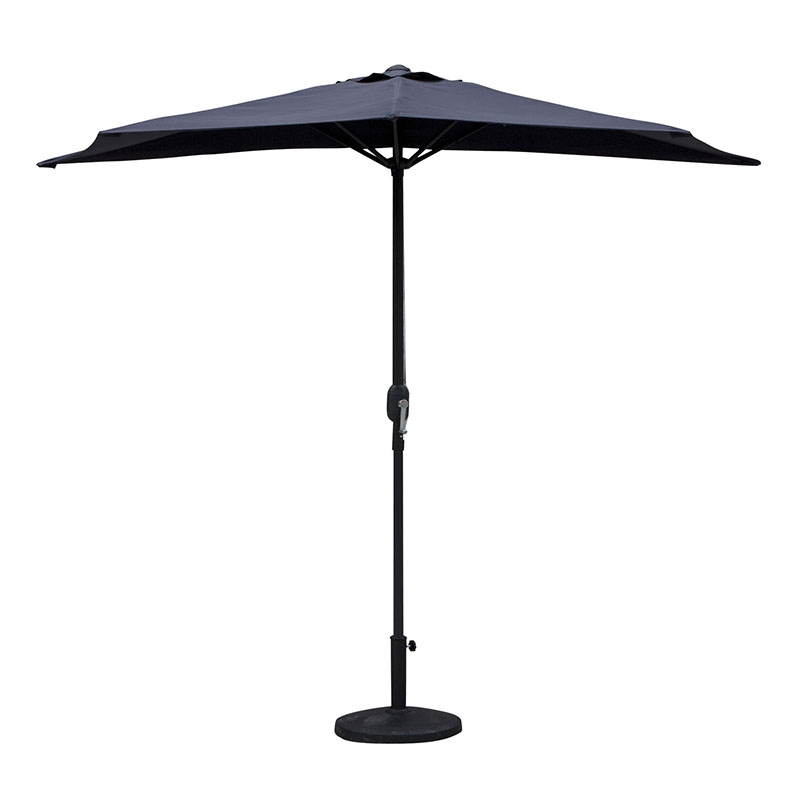 Steel Balcony Umbrella GP1923 for Balconies and CafésSteel-frame balcony parasol in multiple diameters with 160g/180g polyester canopy, suited to balconies, terraces, and café outdoor seating.View Product →
Specifying a Custom Scalloped Canopy
Custom scalloped canopies are easy to produce once the arc, drop and fabric are written into the specification sheet. Vague wording such as “decorative edge” causes most sampling disputes.
- Arc count and width. State the number of waves and the finished width of each, measured on the assembled canopy rather than the flat panel.
- Valance drop. Give the depth in millimetres from the hem line to the lowest point of the arc, typically 60–100 mm.
- Attachment method. Sewn, die-cut or bonded, plus stitch density and thread type if the hem will be handled daily.
- Fabric and coating. Grade, weight, UV rating and colour reference, along with the printing method for logos.
- Frame and ribs. Powder-coat colour, aluminium or steel ribs, since rib end caps sit close to the valance.
- Tolerance and packing. Acceptable arc-width tolerance, usually ±5 mm, and how the valance is protected in transit.
A standard frame keeps reorders simple. Models such as a 24K crank-open garden umbrella in the 2.5–3.0 m range can be supplied with a scalloped valance as a factory option rather than a one-off build. Our custom manufacturing service covers both drawing-based and sample-based development for these orders.
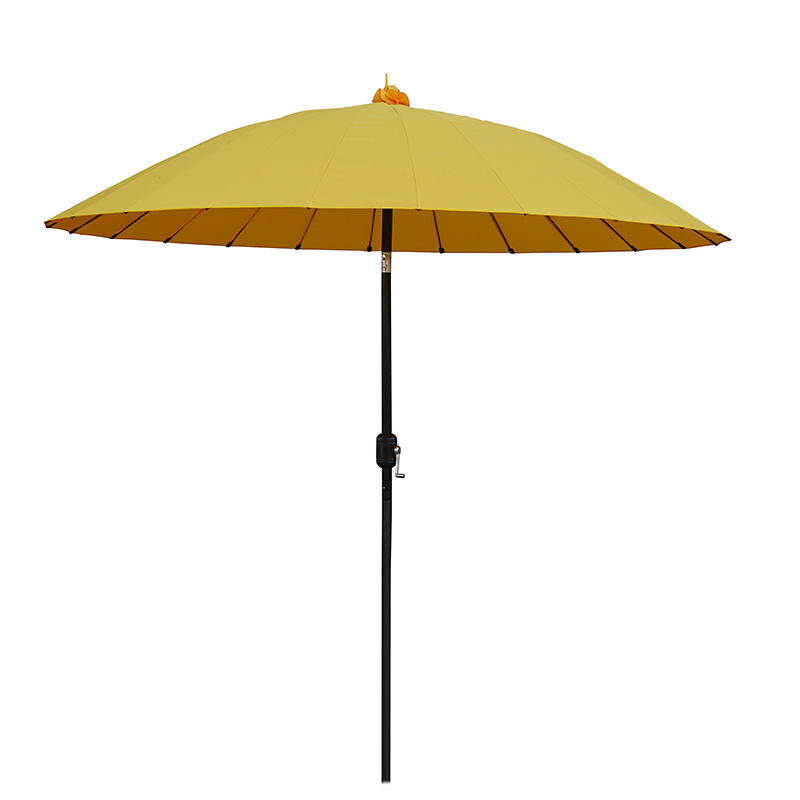 24K Crank-Open Garden Umbrella GP1915 with TiltInclinable garden parasol with steel frame, 160g/180g polyester canopy, crank opening, and zinc alloy tilt adjustment in 2.7m or 3.0m.View Product →
Sample Checks and Common Questions
Three checks catch most scalloped-canopy defects before a bulk order ships: hem drop consistency, arc alignment with the ribs, and colour fastness at the cut line.
1. Hem drop. Measure the drop at every arc on the assembled canopy. Variation beyond ±5 mm reads as a crooked hem once the umbrella is open.
2. Rib alignment. Each arc should sit centred between two rib ends. Off-centre arcs make the canopy pull to one side when tensioned.
3. Cut-line colour. Fray a corner of the valance and inspect the raw edge. A pale core under a dark face will show white lines within a season.
Does a scalloped edge make an umbrella less wind-resistant?
Only marginally. The extra perimeter adds flutter, but tipping force comes from the canopy area as a whole. A vent and a heavier base change wind behaviour far more than the hem shape.
Can any patio umbrella be made with a scalloped edge?
Almost any canopy with eight or more ribs can take one. Canopies under about 2.0 m, or with fewer than six ribs, leave too little room for the arcs to look intentional.
Which fabric holds scallops best?
Solution-dyed acrylic at 240 g/m² or heavier, followed by 220 g/m² PU-coated polyester. Thin 180T polyester curls at the arcs within weeks of sun exposure.
How much does a scalloped valance add to cost?
Expect roughly 3 to 8 percent per unit at container quantities, driven by extra fabric, cutting time and sewing. The cost sits in the valance, not in the frame.
A scalloped edge patio umbrella earns its place when the space has a traditional, garden or resort character and the buyer is willing to specify the details. Write the arc count, drop, fabric grade and attachment method into the order, pair the canopy with a vented frame and an honest base weight, and the decorative hem becomes a dependable part of the product rather than an afterthought.